
Septic and Well Basics for Rural Land in Deschutes County
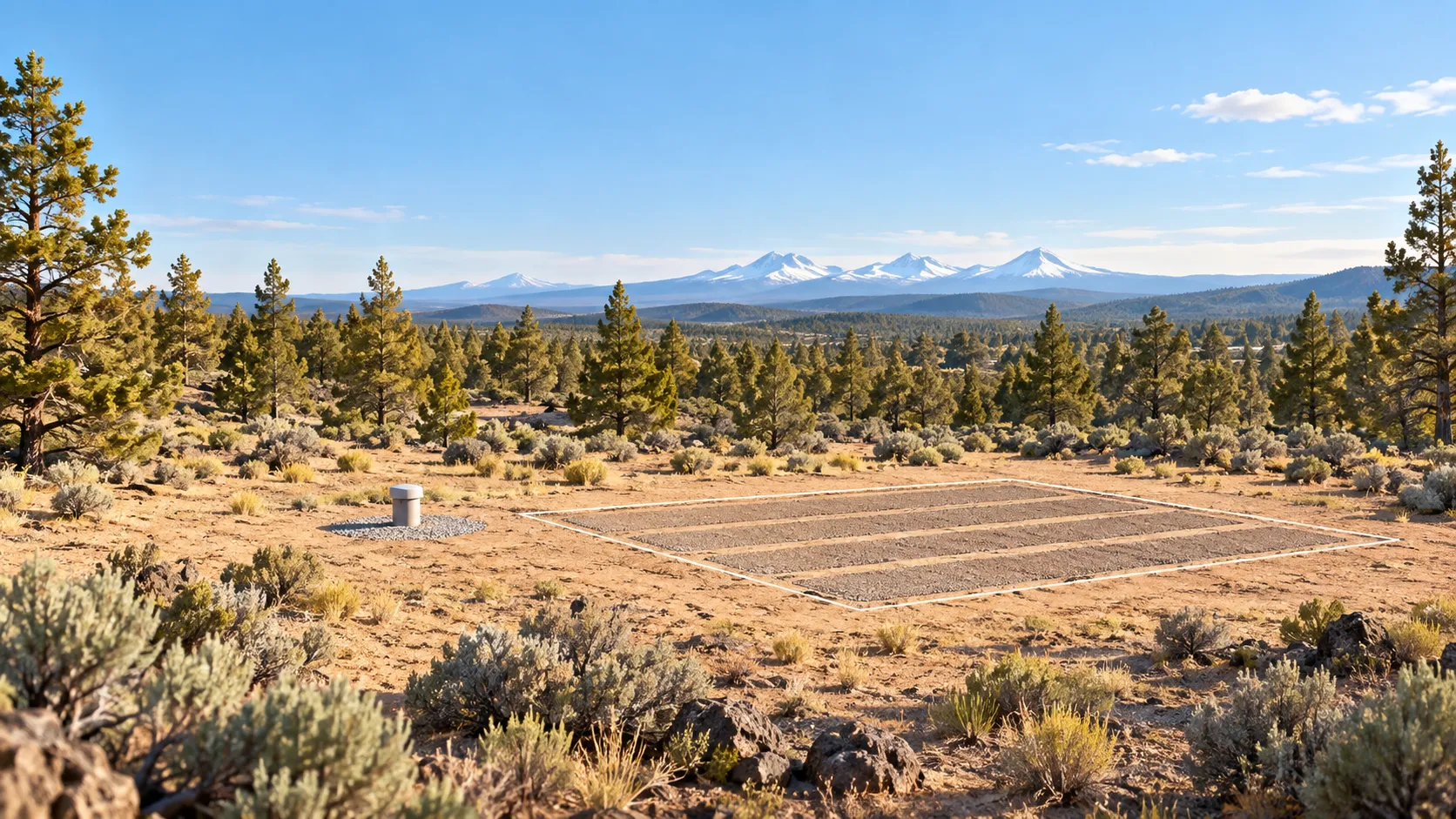
Septic and Well Basics for Rural Land in Deschutes County
Septic and Well Basics for Rural Land in Deschutes County
Select Design & Build Published: October 14, 2026
If your land isn’t served by city sewer and water, two approvals shape your home before design really starts: a septic site evaluation that says what kind of system the soil can support and exactly where it has to go, and a well that can legally and reliably supply the house. Both are specific to your parcel. Both affect the budget, the schedule, and where the home sits on the lot. Here’s how each one works in Deschutes County, in the order you’ll run into them.
Why septic and well come before the floor plan
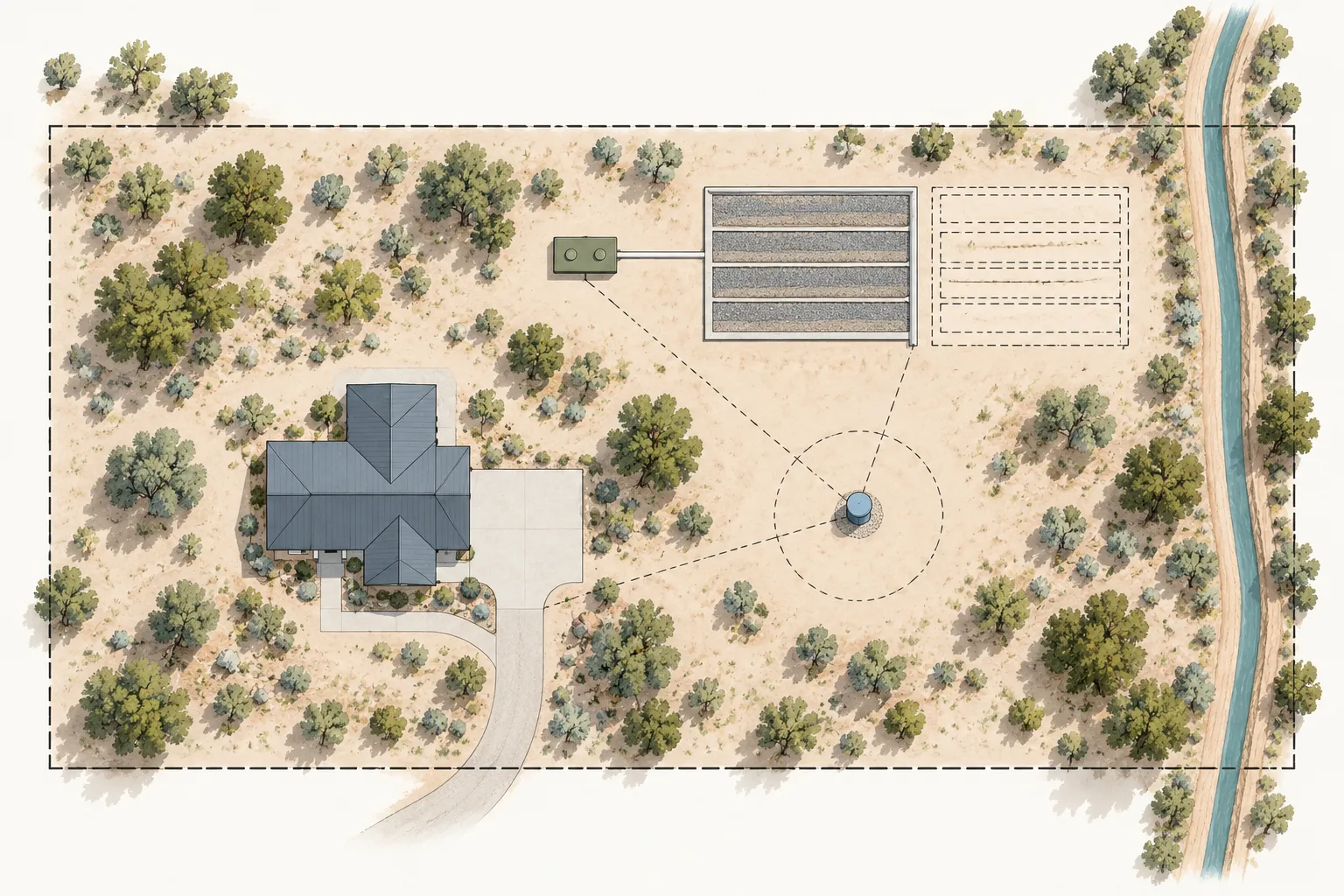
On a rural lot, the drainfield often decides the building site, not the other way around. Oregon’s onsite wastewater rules require a drainfield area plus a reserved replacement area, and both have to stay set back from wells, property lines, building foundations, and water lines. On a two- or three-acre parcel with rock outcrops, a slope, or an irrigation canal along one edge, those setbacks can leave a surprisingly specific footprint for the house.
That’s why the smart order is: confirm the approved septic location and the likely well location first, then place and adjust the home. Starting from a floor plan you love and discovering later that the drainfield has to go where the great room was supposed to face the view is an expensive way to learn this.
Step 1: Check what’s already on record
Before anyone digs, find out whether the parcel already has an approved septic site evaluation. Search the property in Deschutes County’s DIAL tool and open the Development tab, where previous site evaluations and permits are listed.
An existing approval can save time, but read it closely. According to the county’s site evaluation research checklist, the county is generally confident in evaluations less than 15 years old, and it still considers whether the evaluation is complete, whether newer state rules apply, and whether anything about the property has changed. If the parcel has been partitioned or altered, expect to start over.
Step 2: The septic site evaluation
A site evaluation is the county’s investigation of whether your property can treat household wastewater safely. The result tells you the minimum system your site requires and where the approved initial and replacement dispersal areas go. It’s required before the county will issue septic or building permits.
Here’s what the process looks like:
Test pits come first. The county’s site evaluation application guide asks applicants to have three to five test pits excavated before applying. The research checklist describes placing them roughly 60 to 75 feet apart in the area most likely to be used for the drainfield.
A county specialist studies the soil. The key question is how much effective soil sits above rock, restrictive layers, or groundwater, and how that soil drains.
All system types get considered. Oregon’s rules require the evaluator to consider every system type before denying a property. A site that can’t support a standard system may still be approvable with a different design.
Inside Bend or Redmond city limits, a signed city authorization form is required, because the city first decides whether sewer is physically or legally available.
Plan the test pit locations with your builder. Pits dug in the one spot where you’d never want a drainfield don’t help you, and a well-chosen location can protect your best building site and view corridor.

Septic system types you’ll hear about
Your site evaluation will specify the minimum system the site needs. The common categories:
Standard (gravity) systems: a septic tank and drainfield trenches. The simplest option, where soil depth and conditions allow it.
Pressure distribution systems: a pump doses effluent evenly across the drainfield. Often used where effective soil is shallower.
Sand filters and other treatment units: add a treatment step before dispersal on more limited sites.
Alternative treatment technologies (ATTs): engineered units that treat wastewater to a higher standard. In Deschutes County, ATTs come with ongoing obligations, including a maintenance contract, an annual inspection report, and an annual report evaluation fee, as the county explains on its alternative treatment technologies page.
Each step up in treatment adds equipment, electrical work, and in some cases ongoing maintenance. That’s a budget and ownership question to understand before you buy, not after.
South Deschutes County: nitrogen-reducing systems
If you’re looking at land south of Sunriver, know this before making an offer. Groundwater studies in the La Pine area found that conventional septic systems have been polluting the shallow aquifer that supplies drinking water for south county residents. As a result, Deschutes County, working with the Oregon Department of Environmental Quality, requires the highest-performing nitrogen-reducing ATT available for new systems, alterations, and major repairs in the La Pine sub-basin.
That changes both the upfront system cost and the ongoing maintenance picture for a lot in that area. The county’s South Deschutes County requirements page explains how the county and DEQ decide the required level of treatment, and financial assistance programs have been available to help offset ATT costs.
Step 3: Septic permit, installation, and inspections
Once you have an approved site evaluation and a home design, the next step is the onsite permit. Per the county’s onsite permit guide, the permit authorizes a property owner or a licensed installer to install the system, and the application includes a site plan and system-specific documents.
The county then inspects the work. For a standard system, that includes a pre-cover inspection of the tank, a watertightness test, the effluent line, and the drainfield before backfill, and an as-built drawing uploaded before the final inspection. More complex systems have additional inspection steps, listed on the county’s onsite inspections page.
Wells: what Oregon law allows
Most rural homes in Deschutes County rely on a private well. Under Oregon law, single or group domestic use of groundwater up to 15,000 gallons per day is exempt from the water right permit process, and the exemption also covers watering up to a half acre of non-commercial lawn and garden. The Oregon Water Resources Department’s exempt use guidance notes that exempt uses still have to be beneficial and without waste, and they carry the same standing as a water right.
Three details landowners often miss:
The exemption is per property, not per well. Drilling a second well doesn’t double what you’re allowed to irrigate.
A licensed well constructor files the paperwork. After a new well is completed, the constructor submits the well report, a location map, and a $300 exempt use recording fee to OWRD, as described in the OWRD recording fee FAQ.
“Exempt” is about paperwork, not supply. The exemption says you may use the water. It says nothing about how deep you’ll have to drill or how much the well will produce.
Researching water before you buy
You can’t know exactly what a new well will find until it’s drilled, but you can get a good idea. Search the OWRD well log database for wells on neighboring parcels and note their depth, static water level, and reported yield. A cluster of similar logs nearby is a strong early signal. Treat older logs as a starting point, not a guarantee.
If the property already has a well, ask for:
The well log (well report) for that specific well
A recent flow or yield test
Recent water quality test results
The well’s location relative to where a septic system would go
A detail that surprises land buyers: Oregon’s Domestic Well Testing Act requires a seller, upon accepting an offer, to test a domestic well for arsenic, nitrate, and total coliform bacteria and share the results with the buyer and the Oregon Health Authority. But according to the Oregon Health Authority’s well testing guidance, wells on undeveloped land are exempt from that requirement. If you’re buying a vacant lot with a capped well, you may not receive any test results unless you ask for them or order them yourself.
Setbacks that shape your site plan
These minimum separation distances come from Oregon’s onsite wastewater rules (OAR 340-071-0220), published by DEQ in its minimum separation distances table. The evaluator can require more on a particular site.
*A 50-foot drainfield setback can apply to wells constructed to special standards approved by the Water Resources Department.
The irrigation canal line matters more here than in most of Oregon. Many Central Oregon parcels border irrigation district canals, and an unlined canal on the downhill side of your drainfield site can push the system, and the house, somewhere else.
How septic and well affect budget and schedule
We don’t publish cost figures for septic systems or wells here, because they vary too much from one parcel to the next to be useful as a single number. What drives the cost:
System type required by the site evaluation (standard vs. pressure distribution vs. ATT)
Soil depth and rock, which affect excavation and system design
Distance between the tank, drainfield, well, and house, which affects trenching, piping, and electrical runs
Well depth and yield, which drive drilling, pump, and storage decisions
Ongoing costs, such as ATT maintenance contracts and annual reporting
On the schedule side, the order matters more than any single step: site evaluation, then home placement and design, then the onsite permit alongside building permits. Starting the site evaluation early is usually the single easiest way to keep a rural build moving.
Next Steps for Septic and Well Research on Rural Land
Look up the parcel in DIAL and check for an existing site evaluation.
Pull neighboring well logs from OWRD.
If there’s an existing well, request the well log and test results, and order your own tests on vacant land.
If you’re in the La Pine area, plan for a nitrogen-reducing system from the start.
Walk the lot with your builder before choosing test pit locations.
For the rest of the due diligence list, including zoning, access, and legal lot of record, see our building lot checklist for Central Oregon.
How Select plans around septic and well
When we build on your land, site preparation, permitting, and approvals are part of the same plan as the house. In a complimentary design consultation, we look at the lot’s orientation, views, topography, sun, and access alongside where the septic and well can go. From there, plan design lets you start from one of our proven floor plans and adjust it to the approved site layout, or design fully custom around it.
Have rural land, or a parcel under contract? Request a complimentary design consultation or call 541.527.7462.
Frequently asked questions
Do I need a septic site evaluation before I can get a building permit in Deschutes County? Yes, if the property will use an onsite wastewater system. The county requires an approved site evaluation before it issues septic or building permits.
Can I use a site evaluation the previous owner got? Often. The county generally relies on evaluations less than 15 years old, but it still checks whether the evaluation is complete, whether newer rules apply, and whether the property has changed.
Do I need a water right for a household well? Usually not. Oregon exempts single or group domestic groundwater use up to 15,000 gallons per day from the water right permit process. The new well still has to be drilled by a licensed constructor, and the well report and recording fee are filed with OWRD.
Will the seller test the well on a vacant lot? Not necessarily. Oregon’s real estate well testing requirement exempts wells on undeveloped land, so buyers of vacant parcels with a capped well should request or order testing themselves.
This article is general information, not legal, engineering, or real estate advice. Septic and well requirements vary by parcel and change over time. Confirm current requirements with Deschutes County Community Development, the Oregon Department of Environmental Quality, the Oregon Water Resources Department, and a licensed professional before you buy or build.
OR CCB# 234456